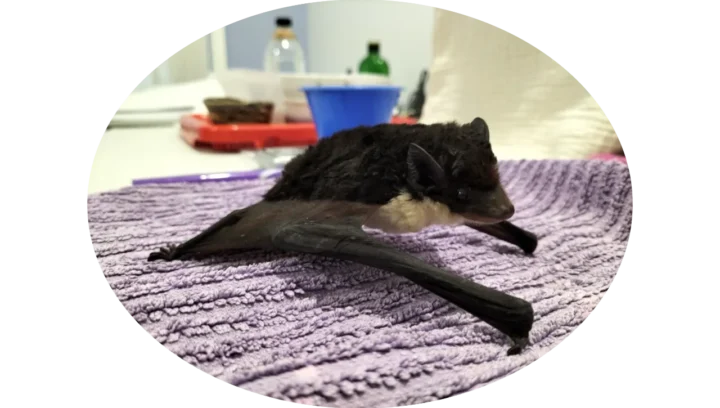


Microbats are small bats with a wingspan of about 25cm and feed on insects such as mosquitos. Many microbats use echolocation to navigate in complete darkness with some species spending their days deep within caves, while others rest beneath bark on trees and in man-made structures such as houses and buildings.
Megabats, or flying foxes as they are usually called, are a lot larger in size with a wingspan of up to 1 metre. They feed on fruit, blossoms and nectar. They do not use echolocation to navigate at night but have well-developed eyes and a strong sense of smell, which helps them locate food. They live in social groups in trees called a “camp” or a “colony”.
Camps
Flying foxes live in communal groups. They prefer tall and reasonably dense vegetation close to creeks or rivers or over swampy areas. Some camps are permanent and are occupied all year round. During summer, these camps are usually the largest and noisiest as they are breeding camps. For the rest of the year, camps are smaller and quieter and often transitory in response to food sources. Permanent camps need an area large enough to allow bats to move within the camp so that damaged vegetation can recover.
Little Red Flying Foxes are the most destructive of campsite vegetation. This is caused by their roosting behaviour of forming dense clusters of up to 30 bats hanging from one small branch. The combined weight of the animals often causes the branches to break. The result is areas of broken vegetation that appears to have been damaged by storms. As clearing of forest vegetation continues, the availability of camp sites has become more restricted and the incidence of damaged vegetation is on the increase. Flying foxes are increasingly setting up camps in suburban areas. This can be in response to destruction of existing areas due to development or the continuous disturbance of campsites. There are other advantages in the form of reliable food sources from garden fruit trees and the policy of councils planting native vegetation. Many campsites previously located in rural areas have been overtaken by the urban sprawl.
Diet
The diet of the Grey-headed Flying Fox and the Black Flying fox consist of fruit, pollen, nectar, stamen and flower parts, leaves and bark. The Little Red Flying Fox is predominantly a pollen and nectar feeder and is a “blossom nomad” and follows the flowering of native vegetation.
Flying Foxes prefer blossoms that consist of light coloured flowers arranged in bunches located on the periphery of the tree canopy. The flowers of most eucalypts, lilly-pilly and melaleuca exhibit these characteristics. They also produce the most nectar and pollen at night. As they gather nectar, they also have deposits of pollen on their chests, which they transfer to other trees. Flying foxes are the major pollinators of eucalyptus and rainforests. Preferred fruit is also in bunches, at the end of branches. A sweet musky odour is highly attractive, but colour is not important for the Grey-headed or Black Flying Fox. Urban bats also eat domestic fruit such as mulberries and mango.
Reproduction
The male flying fox does not begin breeding until around the age of 30 months. The females commence breeding in the second year after their birth, and from then on most of the year is tied up with some part of their reproductive cycle, or caring for young. Females ovulate from February to April and give birth to single young (occasionally twins) from October to December.
The Little Red Flying Fox breeds six months out of phase with the other flying foxes and gives birth between May to July.
Identification
In South-east Queensland, there are 3 species of flying fox which commonly occur. The Grey-headed Flying Fox, Black Flying Fox and Little Red Flying Fox.
Black Flying Fox (teropus alecto)
The Black Flying Fox is the largest of the 3 common species found in South-east Queensland. Adults weigh 600 to 900 grams and have a forearm length of 153mm to 191mm. The Black Flying Fox has black fur often with a reddish-brown mantle on the back of the neck. Its fur is sometimes tipped with white. The lower leg and ankle is unfurred. Some Black Flying Foxes have lighter fur around their eyes.
Their preferred diet includes blossoms of eucalypts and paperbark as well as fruit. This includes the blossoms and fruit of introduced species. They congregate in camps during the day and travel up to 50kms to foraging areas at night. Mating season is in March and April, with the females typically giving birth to single young in October and November.
The Black Flying Fox has a range from Northern Australia from around Shark Bay in Western Australia to central NSW. They also occur in Indonesia and southern New Guinea.
Grey-headed Flying Fox (pteropus pollocephalus)
The Grey-headed Flying Fox adult weighs between 600grams to 1000 grams. They have a forearm of 150mm to 1800mm. The Grey-headed Flying Fox has silver-grey to dark grey fur with rusty-brown to orange mantle encircling the neck. Its fur extends down the legs to the toes.
The diet of the Grey-headed Flying Fox includes the fruit and blossoms of some 80 species. The young are born between September to November and mating takes place April to May.
The Grey-headed Flying Fox has a range from around Mackay in Queensland, along the coastal strip through to New South Wales to Western Victoria. It is endemic to Australia and is listed as Vulnerable under Federal Legislation.
Little Red Flying Fox (Pteropus scapulatus)
The Little Red Flying Fox is the smaller of the flying fox species found in South-east Queensland. Adults weigh 300 to 600 grams and have a forearm of 125 to 155mm. It has a rich reddish-brown to light brown fur all over the body, often with a grey patch on the head. The wings are red-brown and are translucent in flight. There is often light creamy brown fur where the wing membrane and the shoulder meet.
Little Red Flying Foxes are predominantly blossom feeders and since the flowering of Australian plants varies depending on climatic conditions, the unpredictability of this food resource means that the Little Red Flying Fox is highly nomadic. In the camps, which they commonly share with Black and Grey Headed Flying Fox, they hang in tight groups and the combined weight often results in damage to their roost trees. Mating occurs from November to January and the young are born April to May.
The Little Red Flying Fox has a range from Shark Bay in Western Australia through Queensland and down to northern Victoria. They have a range much further inland than the other species.
Flying foxes leave their camps on dusk each day and travel long distances foraging for food. In the mornings, they return to their camp where they spend the remainder of the day resting and socialising. If a flying fox does not return to its camp, it may mean that there is something wrong with it. It could be injured or sick, or perhaps it is a juvenile flying fox that has travelled a little too far and has not had the strength to return to the camp.
If you find a flying fox hanging by itself in a tree or shrub during the day, you should report it to your local wildlife rescue group immediately, even if you do not think that it is injured. When flying foxes hang with their wings wrapped around their body, it can often hide serious injuries. Your local wildlife group will send a vaccinated rescuer to check on whether the flying fox is injured and if it is, they will take the flying fox to receive appropriate treatment and care.
It is very important if you do find a flying fox, that you DO NOT TOUCH IT. You should ensure that you keep all domestic animals away from it and ensure that no one goes near the bat. Remember, they have a wide wingspan so you should keep a safe distance.
Bats, including flying foxes, can carry the Australian Bat Lyssavirus. This disease can be transmitted to humans through a bite or scratch. In Queensland, if you are bitten or scratched, you must contact the Queensland Health Department on 13HEALTH (1343 2584) and they will provide direction to you. In some cases, the Health Department will organise for you to undergo a serious of vaccinations to protect you from any potential disease. All volunteer wildlife rescuers and carers are required to be vaccinated against the Australian Bat Lyssavirus. No unvaccinated person should ever attempt to rescue a sick or injured bat under any circumstances.
For information on Australian Bat Lyssavirus and Hendra Virus please visit the Queensland Health website.
Wildcare receives occasional calls from members of the public seeking advice in relation to issues involving flying foxes. Some of the more common calls that we receive include:-
Can I stop flying foxes from making a mess when they eat fruit from my palm trees?
The easiest way to stop this is to remove the fruit from the palm trees or remove the palm tree itself. The fruit of the Cocos palm can be toxic to flying foxes in any event. In South-east Queensland, Cocos Palms are considered an invasive weed.
We have a lot of gum trees and I don’t like the noise the flying foxes make when they are feeding at night?
The blossom and nectar of gum and melaleuca trees makes up a large portion of the natural diet of the flying fox. Gum trees only flower for a relatively short period of time so the noise shouldn’t last for too long. Remember that flying foxes are the chief pollinators of eucalypt and rainforests so it is important that they have access to their natural diet so that they can continue to pollinate our forests.
How can I stop them eating the fruit off our fruit trees?
Many people have learned to compromise with both birds and flying foxes. You can place paper bags over the low hanging fruit that you wish to keep for yourself; this will ensure that the flying foxes, birds and insects cannot gain access to this fruit. You can then leave the remainder of the fruit higher in the tree for the flying foxes and birds.
How can I correctly put netting around my fruit trees?
If you wish to put fruit netting over fruit trees, there are some very important considerations that you should note for the safety of all wildlife species. Firstly, it is important that you use good quality netting, if you can put your finger through the netting it is not wildlife friendly. Secondly, when installing the netting, drive several stakes into the ground, bend some PVC pipe over the fruit tree and then cover this frame with the netting. You MUST pull the netting taut and secure it well to the ground. If birds or flying foxes then land on the netting they have less chance of becoming entangled as they should be able to fly off the netting.
For more information on the correct method of installing fruit netting visit the DETSI Website.
South-east Queensland is home to over 26 different species of microbats, ranging from the tiny Little Forest Bat weighing 4 grams to the larger Yellow-bellied Sheathtail Bat which weighs up to 60 grams. Microbats are nocturnal and feed on insects, some species ingesting over 400 mosquitoes each per night.
The various species of microbats live in different types of daytime roosts. Some species are cave dwellers, some are tree hollow dwellers, many occupy rock and wood crevices and some even roost in disused bird nests.
Several species of microbat are commonly encountered living in and around houses and urban areas. Often, they are attracted to the insects that swarm towards lights and sometimes find themselves consequently trapped inside houses and buildings.
If you are interested in becoming a volunteer bat rehabilitator, you should contact your local wildlife group and in South-east Queensland there are several wildlife groups specifically dedicated to the rescue and care of bats.
They truly are remarkable and intelligent animals and many wildlife carers have found the experience of rescuing and caring for sick and injured bats to be one of the most rewarding roles.
To learn more about bats, the different species found in South-east Queensland and to find some fun kids activities visit www.allaboutbats.org.au.