

Koalas are arboreal (tree-dwelling) marsupials, with a distribution over most of the eastern part of Australia, although the populations are largely fragmented. They are found in sclerophyll forests and woodland areas ranging from the Eyre Peninsula and Kangaroo Island in South Australia, to the southern-most parts of Victoria (including populations on French, Snake and Raymond Islands) up to the southern edge of the Atherton tablelands in Northern Queensland.
Koalas are folivores, feeding on a diet that is nearly entirely made up of leaves from the Eucalyptus genus, although they will occasionally eat non-Eucalypt species such as Brush Box (Lophostemon confertus), Allocasuarina sp. and Melaleuca sp. Despite there being over eight hundred species of Eucalyptus in Australia, koalas only eat around 40 to 50 of those. In most areas, koalas will have access to around seven species of eucalyptus. Soil type and seasons have a major impact on whether leaf in a certain area is palatable, so whilst they may favour a species of eucalypt from one area, they may not eat it if it comes from a different area. There are also some species of eucalypt that koalas favour only in a specific season.
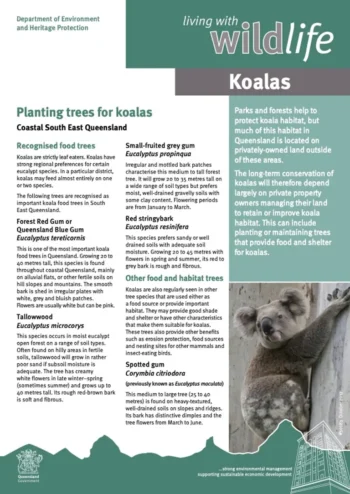
Some of the main browse species in South-east Queensland include:
Secondary browse species include:
For information on koala food trees click on the link below:

Koalas are generally solitary animals and live in relatively well-defined home ranges. In breeding aggregations, these home ranges border or partially overlap adjacent home ranges of other individuals. Home ranges will most often consist of an alpha male whose home range encompasses a number of females’ home ranges. Each female will have her defined area within this range, with most overlapping that of another female. Often a non-dominant or younger male’s home range will slightly overlap one corner or section of the alpha male’s territory.
The size of a koala’s home range is highly variable and depends upon factors such as the koala’s age and sex, forest type, soil quality, reproductive status, area available and the presence of other koalas. In more arid habitat that has less dense forest areas or woodland, the home ranges tend to be larger than those of koalas living in coastal Eucalypt woodlands.
Koalas in some areas can have a very small home range if the koala density in the area is heavy, particularly with dominant males. Fences, roads, abundance and access to food trees also play a part in the size of a koala’s home range.
Koalas tend to be faithful to their home range and will attempt to return if moved elsewhere (relocated). The relocation of mature individuals that are healthy and who are coping well within their home range is discouraged unless there has been a recent and significant loss of habitat. In Queensland, legislation prohibits the relocation of koalas so when it is considered the only option available, several key factors need to be taken into consideration and permission granted by the Department of Environment Tourism Science and Innovation (DETSI).
The koala breeding season in South-east Queensland extends from around August through to January with most young born over the summer months.
Usually a single joey (twins are rare) is born after a 34 to 36-day gestation. The jelly-bean sized joey makes its way through its mother’s fur from the birth canal to the pouch, where it immediately attaches itself to one of the mother’s two teats. The joey will remain in the pouch, drinking its mother’s milk from that same teat, until it is approximately 5.5 to 6 months of age. At this point the joey will become more adventurous and start to climb onto its mother’s belly. The joey will fully emerge from the pouch at around 6 to 6.5 months of age. Once the joey reaches 8 to 8.5 months of age it will be too big to fit in the pouch and will become what is termed a ‘back young’ until it is around 12 months of age. Koalas are usually excellent mothers and are highly tolerant of their energetic young. Complete independence from the mother occurs between 12 to 18 months of age.
Sadly, the highest incidence of mortality in koala joeys occurs during the pouch emergence stage.
Between 18 months to 2 years of age juveniles generally move away from their maternal home range to establish their own territory. Females will often choose to set up a home range that will overlap their mother’s or will settle not too far away.
During this dispersal time, juveniles may travel a great distance and are at a much higher risk of being injured by a dog, hit by a car, or other misadventure.
Sexual maturity is from around 2 years onwards.
Koalas have few natural predators other than man, but young can fall victim to birds of prey, pythons and dogs, both wild and domestic. Adult koalas mostly come to grief because of motor vehicles, domestic dogs and disease. There is a much higher risk of harm in areas where habitat loss is occurring.
The male koala has a prominent sternal gland (on the chest), which results in the fur in this area being stained an orange/brown colour. This gland becomes noticeable as the male gets older and is increasingly prominent in breeding season when both the gland and the emulating odour are present.
Male koalas emit a very loud bellow vocalisation, which can sound quite eerie if you happen to be out in the dark. Young males, however, sound like a squeaky frog as they develop their bellowing skills. Both male and female koalas have a variety of vocalisations to indicate a variety of emotions and situations.
The Queensland female koala has a weight range of between 4.1kg and 7.3kg with an average of 5.1kg. Although the occasional 8kg to 9kg individual has been recorded, female koalas of this size are not common.
The Queensland male koala has a weight range of between 4.2kg and 9.1kg with an average of 6.5kg. Koalas in southern New South Wales and Victoria have a much heavier average weight than Queensland koalas with Victorian koalas being the heaviest of all the states.
The dorsal (back) fur of the koala is the most insulated of any marsupial found to date, and in the past, was heavily sought after for the fur industry. The ventral (belly) surface has half the density of the dorsal surface and is more reflective of solar radiation. In cold weather, koalas will curl into a ball with the dorsal fur providing effective insulation from the cold and rain. In warmer months, they will often sit sprawled out with their ventral surface exposed to the sun, which has a cooling effect. Panting is the main means of evaporative cooling in high temperatures. Although some sweat glands exist on the hand and foot pads this is not an outlet for overheating. In extremely hot conditions, koalas have been known to seek refuge in caves and fallen tree hollows.
Koalas have strong, razor-sharp claws that can cause severe injuries. They can also bite tremendously hard. Although they may appear docile, they are capable of lashing out very quickly if they feel threatened. Even very sick koalas can react aggressively when handled. We do not recommend that anyone attempt to handle a koala unless they have been specifically trained to so do.
If you do find a sick or injured koala on the ground, we recommend you secure the koala by placing an overturned laundry basket or large box over it to prevent it from wandering off or climbing a tree. This makes it quicker and easier for a wildlife rescuer to collect the koala. Never encourage a sick or injured koala to climb a tree as this makes it much harder for us to retrieve it. Once captured, sick or injured koalas must be housed and transported in a large, secure wire mesh cage to prevent escape.
Reports of sick and injured koalas can be made to Wildcare or to your local wildlife care organisation so that a specially trained volunteer can assess and capture the koala if required.
Below is a list of the most common scenarios regarding koalas that our volunteers encounter.
Koala out of place in a suburban area
It is not uncommon for koalas to be found in residential areas. Given the threats of domestic dogs and/or motor vehicle traffic, it is natural to be concerned about the animal’s safety.
Koalas are often spotted whilst making their way between one food tree and another and will generally retreat to another tree (including non-Eucalypt species) for protection during their journey. If the koala is within a known koala corridor, it is best to leave it to find its own way back to a suitable tree.
Koalas can become disorientated very quickly so stand well back from the koala and keep dogs, children and other adults clear of the area so that the koala can come down and continue on his way when he feels it is safe to do so.
If the koala appears to be injured or shows signs of disease, please call your local wildlife rescue organisation so that a specialised koala rescuer can assess the animal.
If a koala is found in an area that is not a known koala corridor, please contact your local wildlife rescue organisation who will be able to provide further advice and/or organise for the koala to be rescued if appropriate.
Koala sightings
There are a number of programs in Queensland where residents can report sightings of koalas.
Visit the website of your local Council and search for ‘koalas’. Most councils have comprehensive information on koalas in their local area and some have a preferred method for you to log your koala sightings.
In the Gold Coast region, the City of Gold Coast has an online reporting form:
REPORT A KOALA SIGHTING ONLINE
In Queensland, you can also report koala sightings to the Department of Environment Tourism Science and Innovation (DETSI) through the QWildlife app for IOS and ANDROID.
Reporting koala sightings is a very important tool which aids Governments at all levels to make better decisions.
Encounter with a dog
Koalas often cross through residential yards to access suitable habitat or food trees and this puts them at risk of being injured if they come into contact with a dog.
For information on making your yard koala-friendly, please click on the links below:
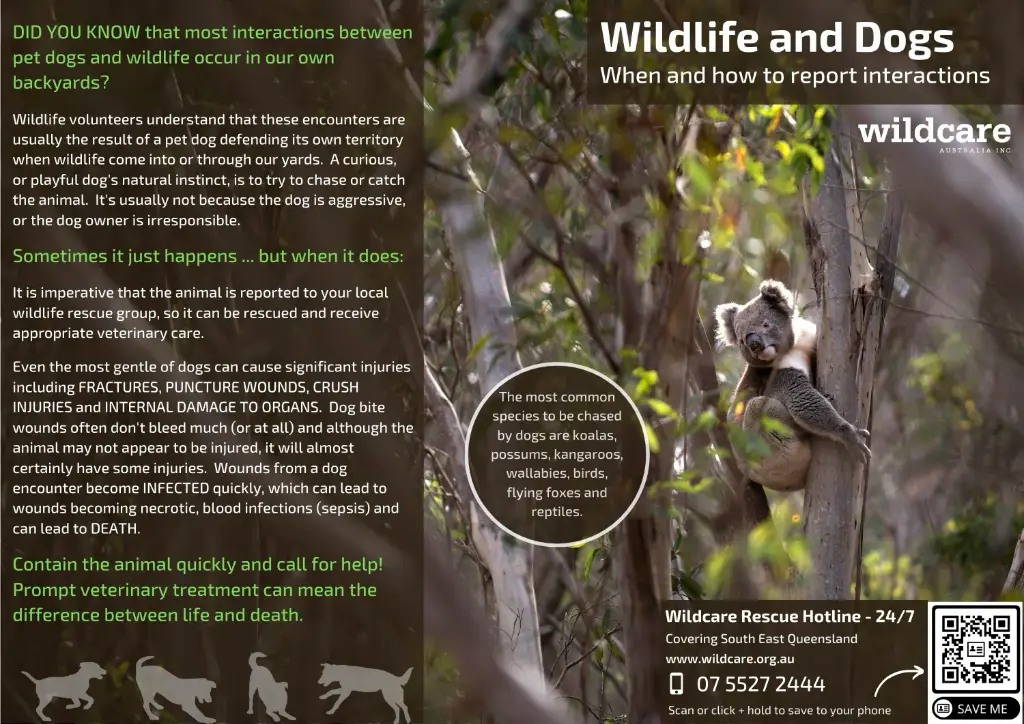
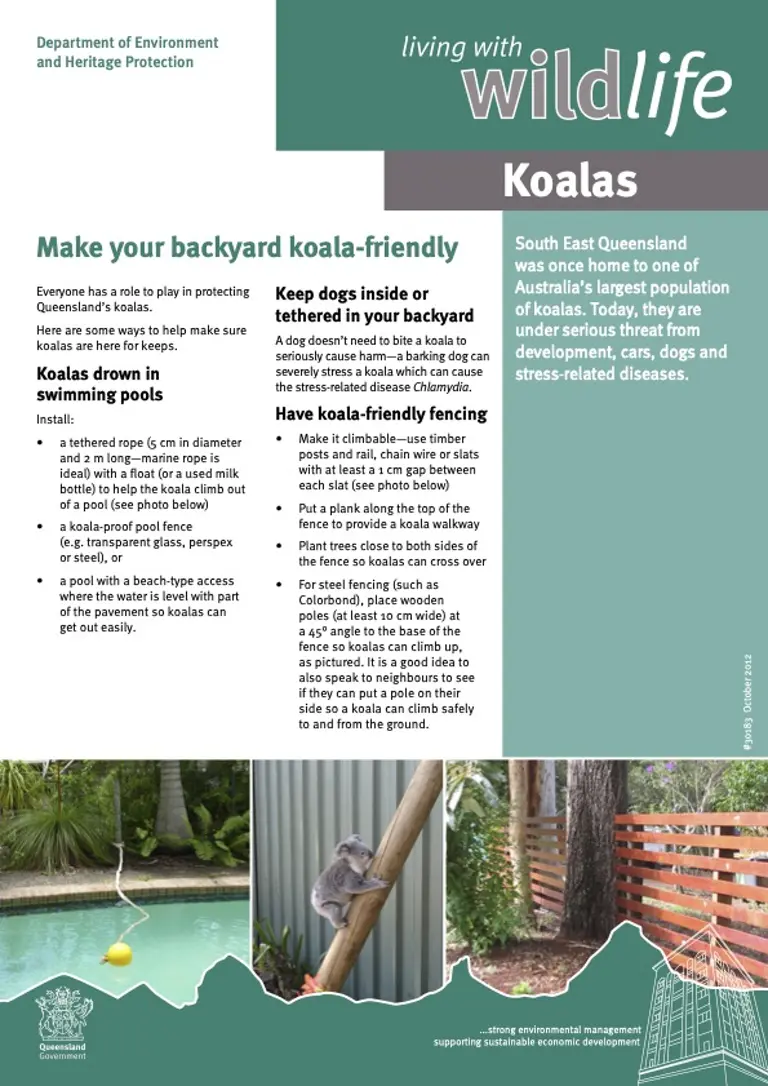
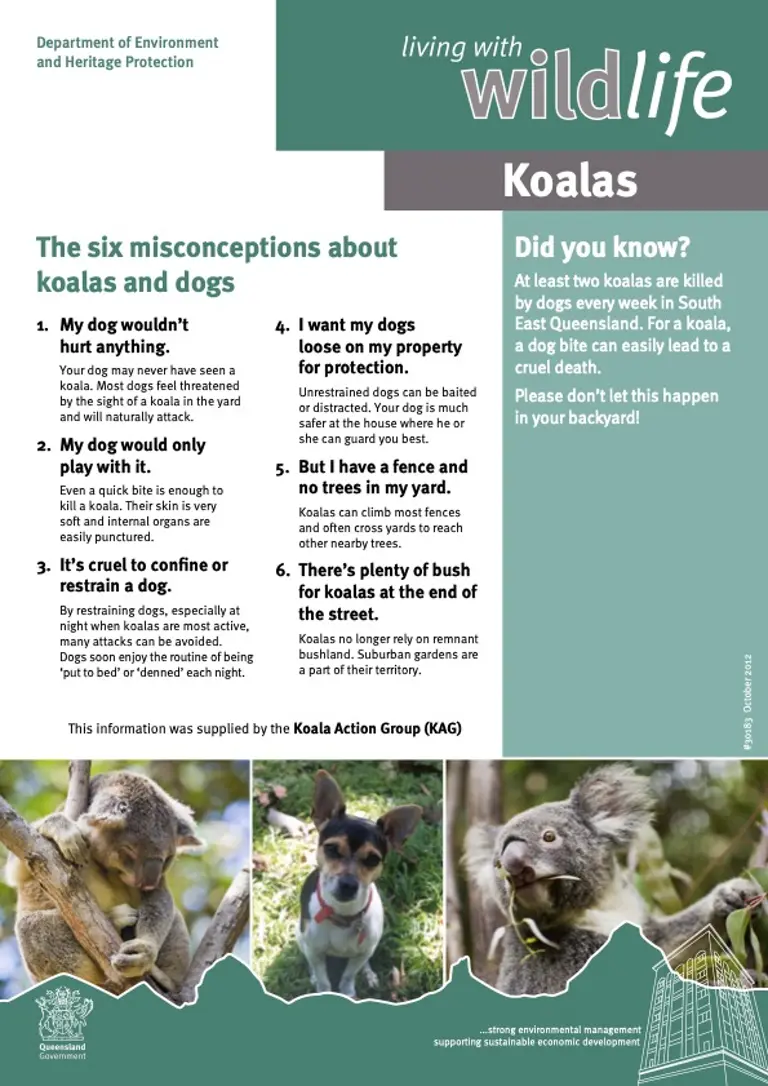
In the event that your dog does come into contact with a koala, it is important that the koala is immediately reported to a wildlife rescue organisation so that it can be rescued and checked by a wildlife vet. Wildlife volunteers understand that despite the best efforts to make your yard koala-friendly, and even though you may have a very placid, gentle dog, sometimes these incidents do still occur.
Koalas have very thick skin and fur but the pressure from a dog bite can cause life-threatening internal injuries which can be difficult to identify without a thorough veterinary assessment. There is often even no sign of blood. Even small puncture wounds from a small ‘nip’ can quickly become infected. With prompt veterinary treatment, the koala will have a better chance of a successful outcome.
If your dog has come into contact with a koala, please take the following steps immediately:
Vehicle impact
If you have accidentally hit a koala, please call your local wildlife rescue organisation immediately. All wildlife groups have volunteers that will attend these calls even throughout the night.
If you find a koala sitting on or next to the road, it may have been hit by a vehicle. They often have visible signs of injury however sometimes they appear to be dazed but otherwise uninjured but they may still be suffering from internal bleeding.
If you do find a koala that has, or is suspected of having been hit by a car, please:
Baby koalas
During breeding season, we often receive calls regarding baby koalas (joeys) that are believed to be too young to be on their own.
In most cases, the koala is actually a young sub-adult that is starting to disperse from its mother, so it is important to be able to identify a dependent joey from an older dispersing one.
How to tell if it really is a baby koala:
For baby koalas:
Koala in a pool
Koalas can swim confidently, however if they fall into a pool and cannot easily get out, they become exhausted and can drown.
If you find a koala in your pool:
If you have found a deceased koala in your pool, please refer to the section below on Deceased Koalas.
Sick koala
Unfortunately, koalas are prone to a number of diseases and injuries, and reports of sick koalas are one of the most common calls that wildlife rescue organisations such as Wildcare receive.
Some diseases of wild koalas are easily recognisable while others are only detectable by a thorough assessment by an experienced wildlife veterinarian.
How can you tell if a koala is sick or injured?
If you live in an area where you frequently see koalas, it is good practice to keep an eye out for any signs of injury or disease. The sooner a sick koala receives veterinary treatment, the better its prognosis.
The following table provides a guide of the differences between a healthy and sick koala.
Coat:
• Should be dense, grey and uniform
• Female koalas with back young or recently weaned young may show patchy fur loss and dark grey or brown patches around the shoulder region.
Body Condition:
• Should be well nourished and slightly pot-bellied.
• Pelvic bones and spine should not be discernible.
• Body condition can be hard to assess distantly.
Demeanour:
• Bright, alert and responsive to disturbance
• Ears should become erect when disturbed
Eyes:
• Should be clear, bright and free of discharge
• Should have no fur loss around the eyes
Vent and Rump:
• Bottom should be clean, white and dry
• Free of dirt or dark brown stains
Position:
• Healthy koalas should be up a tree during the day.
• If on the ground, they should move away when approached.
Mouth and Nose:
• Should be clean and free of discharge or drooling
Breathing:
• Breathing should be barely discernible
Coat:
• Brown, sparse, coarse or tufted in appearance
• Hair loss
• Scaly, encrusted skin
• Any signs of wet fur which might indicate saliva from a dog
Body Condition:
• Hollowness between the ribcage and pelvis
• Pelvic bones and spin easily discernible
Demeanour:
• Unresponsive
• Able to approach closely
Eyes:
• Crust formed over the eyes
• Inflammation around the eye
• Pus forming in the eye
Vent and Rump:
• Wet bottom
• Dark stained bottom (brown colour)
Position:
• Sleeping on the ground
• Sitting at the base of a tree for a period of time
• Does not move away when approached
Mouth and Nose:
• Discharge
• Drooling
Breathing:
• Open-mouth breathing
• Panting
• Laboured or noisy breathing
Koalas, like most wild animals, can mask their signs of illness well. Any koala sitting on the ground which doesn’t move off when approached could be unwell. If you are concerned that a koala in a tree could be unwell, check on it at varying intervals (including at night) as some koalas will return to the same tree to sleep each day but will move to other trees during the night to feed. Healthy koalas tend to move around within an area from night to night, whereas sick koalas may stay in the same tree for prolonged periods.
Some of the diseases found in koalas in South-east Queensland include:
Chlamydiosis / Chlamydia
This is a serious, debilitating and sometimes fatal disease caused by two different strains of the bacterium Chlamydia. It commonly causes ocular (eye) and urogenital (urinary/genital) disease manifested by keratoconjunctivitis (pink-eye), infertility and urine staining of the rump caused by cystitis (dirty tail).
Chlamydial disease is often complicated by secondary infections with other bacteria and fungi and is exacerbated by a number of factors including chronic stress, poor nutrition and immunosuppressive diseases.
Spread of the disease is almost certainly by the venereal route (sexually transmitted), and possibly also by close contact and flies.
Koalas suffering from Chlamydia have a good chance of recovery if they are treated in the early stages of the disease.
Starvation / Metabolic Failure
Manifested by weight loss, depression, dehydration and sometimes, concurrent disease. This condition is common in koalas, where the loss of habitat is having a tremendous impact on their ability to survive.
Bone Marrow Disorder, Cancer and Immunosuppression
There is evidence for the existence of a pathogenic retrovirus that infects koalas. It may cause bone marrow suppression leading to anaemia and immunosuppression, lymphoid neoplasia and other cancers. It may also cause an AIDS-like syndrome. With the exception of lymphoma, which causes enlarged lymph nodes, most of these diseases can only be detected by careful interpretation of blood tests by an experienced wildlife veterinarian.
Deceased koalas
In Queensland, comprehensive information is gathered by the Queensland Government in conjunction with wildlife hospitals and wildlife rescue organisations regarding koalas. Information regarding their rescue location, age, sex, injuries and diseases plays an important part in koala research and includes collection of DNA samples.
It is preferable that all deceased koalas are taken to a wildlife hospital so that this information can be gathered.
In South-east Queensland, deceased koalas can be taken to the following facilities:
Gold Coast
Currumbin Wildlife Hospital
27 Millers Drive, Currumbin
Ph: 07 5534 0813
Open 8am to 5pm every day (except Christmas day)
Logan / Scenic Rim
Moggill Koala Rehabilitation Centre
55 Priors Pocket Road, Moggill
Ph: 07 3202 0231
Available 8am to 4pm (Monday to Friday only)
Brisbane
RSPCA Wildlife Hospital
139 Wacol Station Road, Wacol
Ph: 07 3426 9999
Ph: 1300ANIMAL
Available 7am – 7pm
Moreton Bay / Sunshine Coast
Australia Zoo Wildlife Hospital
1638 Steve Irwin Way, Beerwah
Ph: 07 5436 2097
If you are unable to take the koala to one of the above facilities, please contact your local wildlife rescue organisation who may be able to assist.
If the body is quite decomposed, try to establish as much information as possible (e.g. male/female, approximate size, obvious injuries, address etc.) and log these details with either your local Council or local wildlife rescue organisation.
In South-east Queensland, all koalas that have been in care are microchipped prior to release. Many of them are also ear-tagged. The ear tags will vary in colour depending upon which facility placed the tag.
Koala with an ear tag
In South-east Queensland, all koalas that have been in care are microchipped prior to release. Many of them are also ear-tagged. The ear tags will vary in colour depending upon which facility placed the tag.

All records relating to koalas that are rescued/rehabilitated are provided to the Department of Environment Tourism Science and Innovation (DETSI) who collate the information from the various rescue and care groups and wildlife hospitals. This means that if a koala is found with an ear tag, it is possible to identify it and establish its history.
In South-east Queensland, koalas are classified as a ‘specialised species’ under the Nature Conservation Act 1999 and as such, you must hold a special Rehabilitation Permit to rescue, release or care for sick, injured or orphaned koalas. Caring for koalas is a specialised skill and is generally undertaken by wildlife rehabilitators that have several years’ experience with caring for other wildlife species.
Rescuing koalas requires the use of specialised rescue equipment including flagging poles, nets, koala traps and large transport cages. If you are interested in learning how to rescue koalas, consider joining Wildcare and attending appropriate training to learn more about koalas.
For more information on koalas, check out the following brochures and information sheets: