


The term ‘macropod’ is used to describe the marsupial family Macropodidae, which includes kangaroos, wallabies, tree-kangaroos, pademelons, bettongs and several others. They are generally recognised by their long powerful hind legs and feet.
The larger species of macropods, such as kangaroos and large wallaby species, are considered “mob” animals as they reside in large groups of animals that consist of females, their young and a dominant male. Other species are solitary, coming together only during breeding season, although they will often congregate in feeding areas but will then disperse individually.
Macropods are found in a variety of habitats including grasslands, woodlands, dry and wet eucalypt forests and tropical and dry rainforests.
In South-east Queensland, the most common species of macropods include:
Macropods are unique in that all species but one (the Musky Rat-Kangaroo) “hop” on their hind limbs. They cannot walk backwards or move their hind legs independently except when lying on their side or swimming.
When hopping, macropods place only a small portion of their hind feet on the ground and use their tail for balance. On uneven ground, macropods use their tail extensively to maintain their balance.
When walking, the larger macropod species move slowly and use their hands, feet and their tail. The smaller species of macropods move in the same manner however they tend not to rely on their tail as much, often dragging it behind on the ground.
The shape of the hind foot varies greatly between species depending upon the type of habitat in which they live. Species that live in grassland areas, such as the Grey Kangaroo and Red Kangaroo, have a long, narrow hind foot.
Species that live in rocky habitats have a broader, and generally shorter, hind foot.
Macropods have a strong tail, which varies greatly in length between species. They use their tail extensively for balancing, not only when hopping and walking, but also when fighting and grooming.
The diet of macropods is basically herbivorous eating a variety of native grasses, herbs and shrubs. Some species will also eat a variety of insects.
Macropods use a wide variety of vocalisations to communicate in various circumstances. Females will communicate with their young by making soft clucking sounds. A macropod joey will communicate with its mother when stressed by making a loud guttural coughing noise. Males will communicate with other males in territorial disputes by making a variety of threatening vocal sounds such as hisses and guttural coughs.
Female macropods have a well-developed forward-opening pouch, which contains four teats.
Gestation lasts only three to five weeks. When the female is nearing time to give birth, she spends considerable time cleaning the pouch. Immediately prior to the birth, the female will position herself in such a way as to give the foetus the best chance of reaching the pouch safely. Grey Kangaroos tend to stand while giving birth while most other species sit on their rump with their tail and hind legs out in front. The female will clean her urogenital area and lick a path from her cloaca to her pouch. When the foetus emerges from the urogenital opening it is enclosed in an amniotic sac from which it breaks free with its claws. The foetus then instinctively climbs, unaided by its mother, to the pouch entrance. Once inside the pouch, the foetus attaches itself to one of the four teats.
From the time of birth to the time of weaning, the macropod joey will feed from the same teat. When it is older and has left the pouch, the mother may give birth to another joey. When a younger sibling is born, it will attach to and feed from one of the remaining three teats. The mammary glands of a macropod can supply two young with different ages with milk of different composition.
Most macropod species breed continuously throughout the year. During times of severe drought, they will not give birth but will wait until conditions are better.
All macropods, including small species such as pademelons and bettongs, have a very powerful kick and can cause significant human injury. Sub-adult and adult macropods are very difficult to restrain manually, and most will require sedation to enable them to be safely transported for treatment.
We do not suggest that any person attempt to capture or restrain an adult macropod if they have not been trained to do so. Adult macropod rescues require specialised rescue equipment to ensure the safety of yourself, the public and the animal. It is unsafe to put a conscious macropod in your vehicle as it may lead to you having an accident.
In most cases, injured adult macropods will require an experienced wildlife rescuer to attend and preferably one that is able to sedate the animal prior to transportation.
There are varied reasons why macropods need our help, many of which are directly as a result of human impacts. We have listed below some of the common reasons why they need to be rescued and have provided some tips as to how YOU can help.
Orphaned Joeys
It is important that orphaned macropod joeys are transferred to an experienced wildlife carer as soon as possible as they have very specialised feeding and warmth requirements.
Macropod joeys can develop myopathy quickly. Myopathy is a stress-related condition that destroys the muscles (including the cardiac muscles) and can quickly lead to death. There is little chance of recovery for macropods suffering from acute myopathy and joeys that are subjected to a high degree of stress will not survive. Stress can be caused by overhandling the joey, exposing it to domestic dogs and cats, not keeping it contained in a pouch and making it ‘hop around’ when it should be securely in a pouch environment.
Joey’s whose mothers have been the victim of trauma-related injuries (such as hit by car or injured by a dog), must receive a full assessment by a wildlife veterinarian as they too often sustain injuries such as fractured limbs, internal bleeding, bruising and/or myopathy. These injures are difficult to identify without the aid of x-rays and blood tests. All injured macropod joeys will require pain relief and antibiotics if they are to be given a good chance of survival.
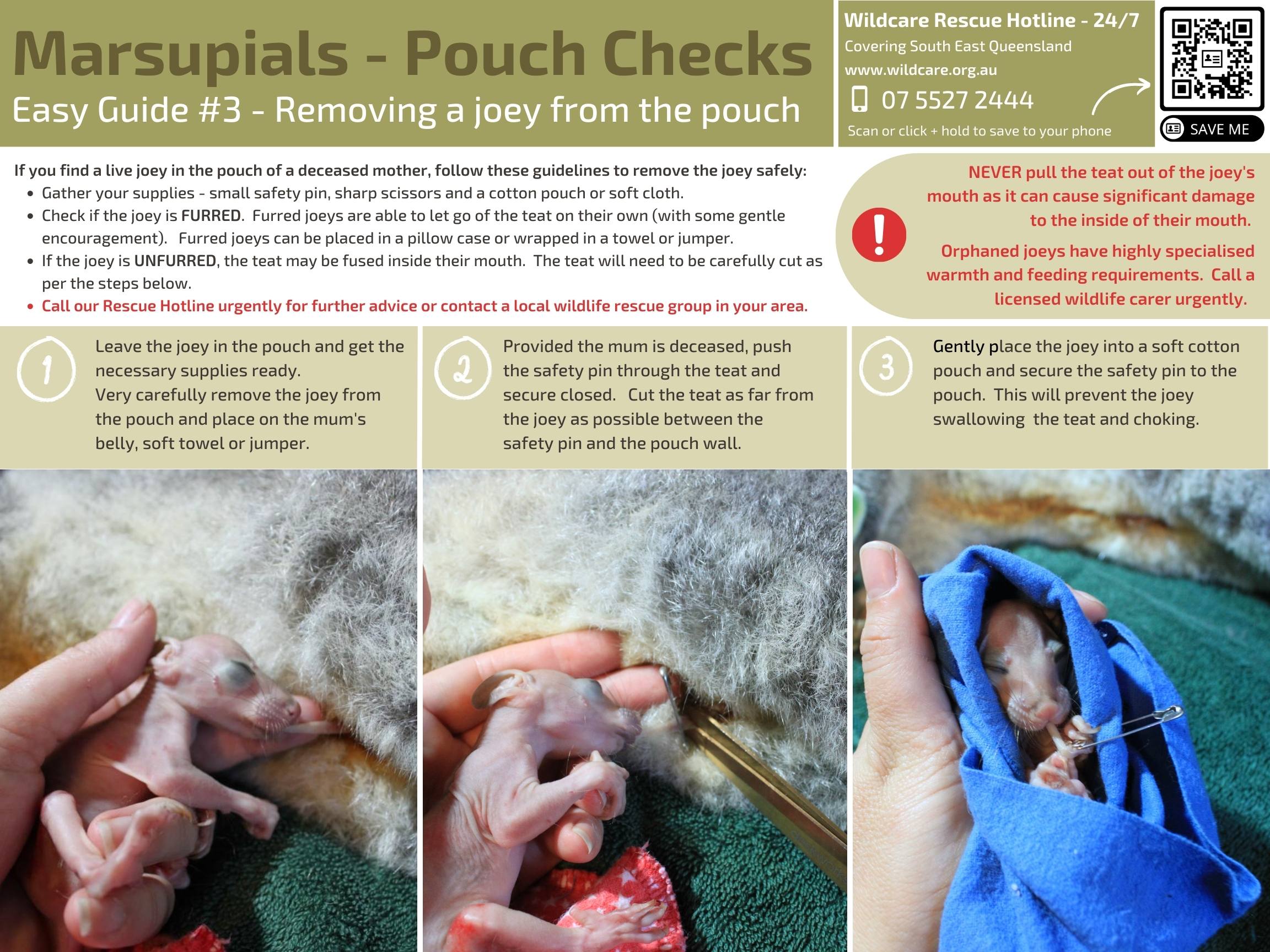
If you find a dead female kangaroo and the joey is alive and still in the mother’s pouch:
If the joey is no longer in the pouch, but standing near the mother’s body:
If you find a dependent joey on its own with no sign of the mother:
Deceased Macropods
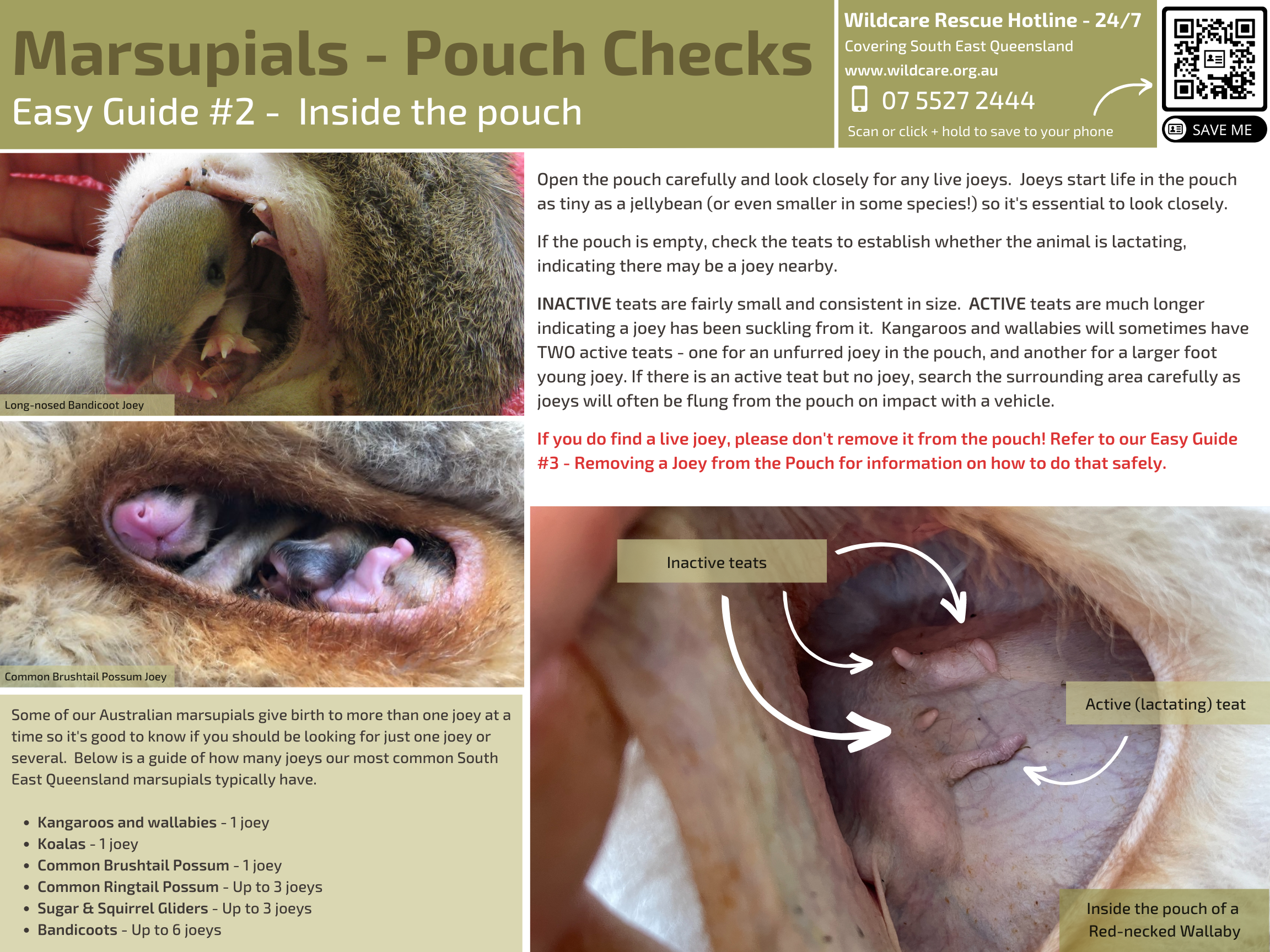
If you find a deceased kangaroo or wallaby, it is important to check if it is a male or female. Female macropods should be checked carefully to ensure that there is no live joey in the pouch. Check the surrounding area carefully as often joeys are flung from the pouch on impact with a vehicle.
If you find a deceased macropod and aren’t sure how to check if it is a male or female, you can refer to our Easy Guides on pouch checks linked below:

Encounter with a dog
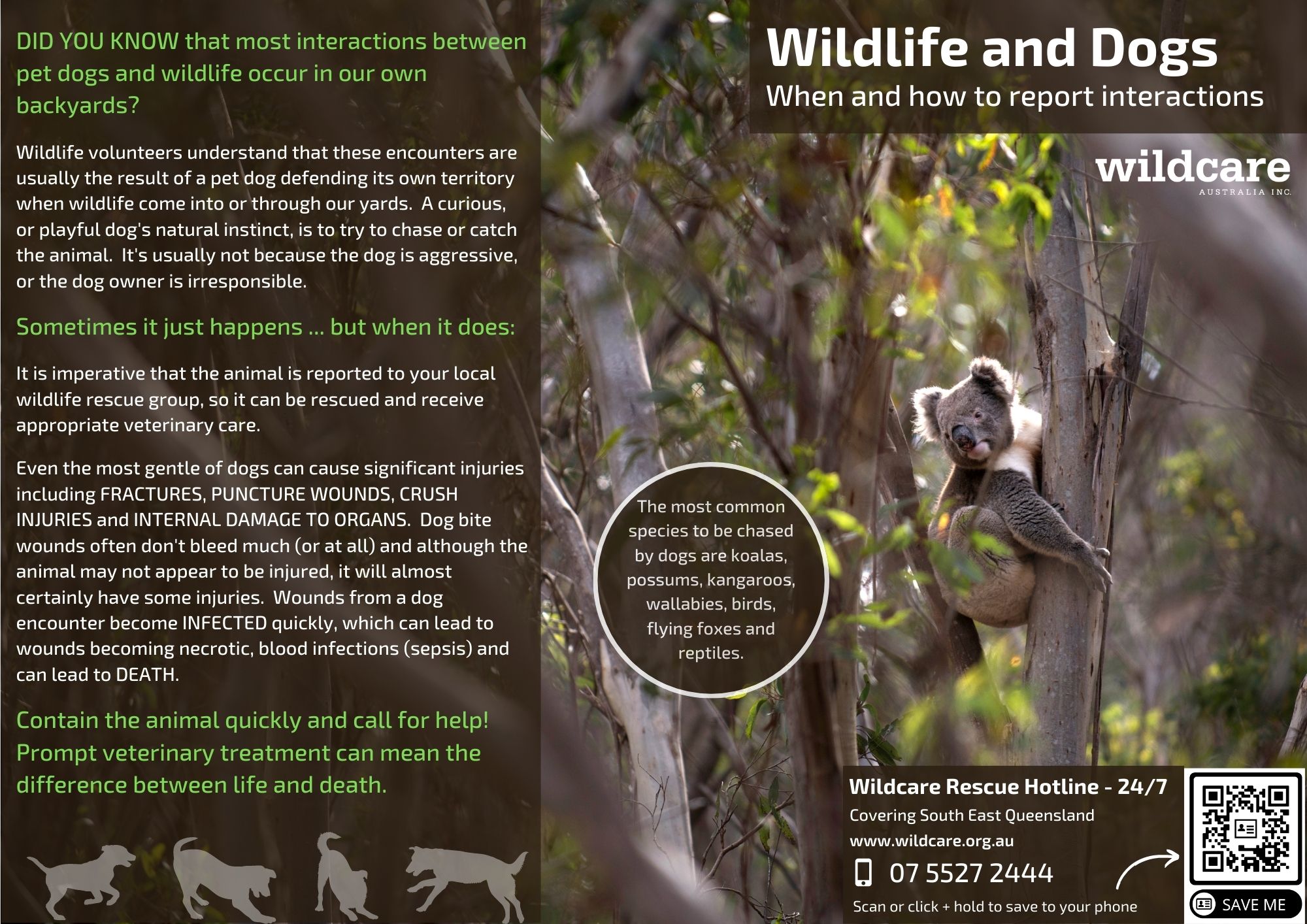
In the unfortunate event that a dog chases, and/or comes into contact with a macropod, it is important that the incident is reported to your local wildlife rescue group. Time is of the essence in these situations, as the animal is often still mobile. Please observe the animal closely from a safe distance until a specially trained wildlife rescuer arrives. In some instances, the animal may need to be tranquilized with a dart gun in order to be captured and veterinary treatment sought.
Macropods that appear to have only minor injuries still require urgent attention. Even just one bite from a dog can lead to infection and lead to death.
Remember, macropods suffer tremendously from stress so please ensure that any dogs are quickly removed from the area and placed out of sight from the animal.
Sick Macropods
Reports of sick kangaroos and wallabies are not uncommon and often present in poor body condition which can be the result of a previous injury, infection or old age.
Contact your local wildlife rescue group who will be able to provide further advice. An experienced macropod rescuer will consult with a wildlife veterinarian to determine the most appropriate outcome for the animal.
Lost or displaced macropods
Periodically macropods will be reported to be in an unusual location on their own, particularly in urban areas.
There are several reasons why this may occur including:
If the animal does not appear distressed and does not appear to be visibly sick or injured, then we recommend observing the animal for a while. If the animal is distressed, it is important NOT to chase or herd it as this will only make it more stressed and can induce capture/exertional myopathy, which can easily result in its death. It also makes it much more difficult for wildlife rescuers to get close enough to it to sedate it.
Please report individual animals in unusual locations to your local wildlife rescue group as they will often monitor the animal to ensure that it is safe and healthy.
Swimming in a canal or water body
Macropods are generally confident at swimming, and it is not unusual for them to move through watercourses. However, in urban areas there are many man-made water bodies, such as canals with concrete walls, that do not allow them to exit easily.
If there are no easy exit points for the animal, please contact your local wildlife rescue group. Otherwise, keep an eye on the animal from a safe distance and ensure that it reaches safety.
Entangled in a fence
Macropods often become entangled in fences, particularly dog/goat wire, barbed wire or pool fencing.
It is important to remain well clear of the animal to reduce stress and further injury. Please do not attempt to remove the animal yourself unless instructed by an experienced wildlife rescuer.
Macropods caught in wire fencing quite often have extensive muscle damage or even fractured limbs. If the animal is cut free, it may take off and not be able to be captured which will lead to pain and suffering and most likely, death. Please call a wildlife rescue group immediately so the animal can be safely contained, preferably sedated, then cut free and transported for veterinary care.
Trapped in a yard
Macropods are frequently found trapped in yards, particularly in urban areas.
Because macropods are easily stressed and can injury themselves when spooked, the best course of action is to leave the animal alone and let it find its own way out of the yard. Attempting to capture and restrain an otherwise uninjured and healthy sub-adult or adult kangaroo or wallaby, increases the risk of injury to the animal and the onset of myopathy, which may lead to death.
In these circumstances, ensure that all domestic animals are removed from the area and remain out of sight. Open all possible gates on the property and stay well away from the animal.
If the animal does not move out of the yard within a few hours, or you are unsure as to whether the animal requires attention, please contact your local wildlife rescue group.

