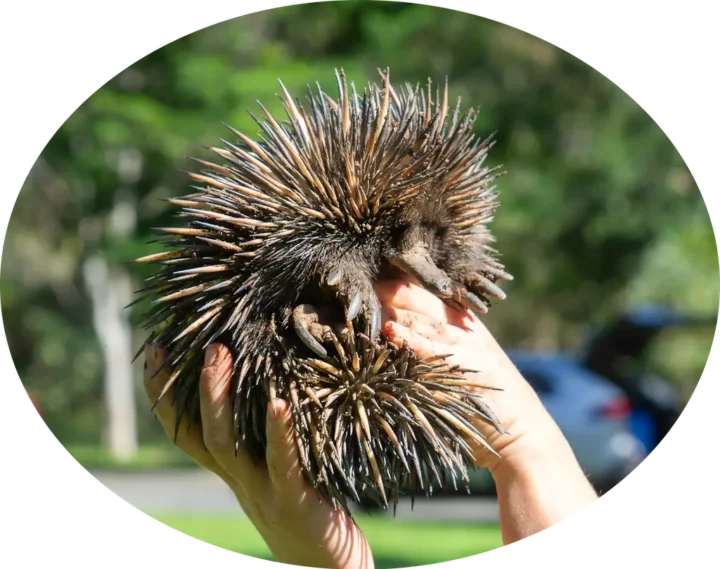


Echidnas are the oldest surviving mammal, with five sub-species of short-beaked echidnas found in Australia. Their close relatives, the long-beaked echidnas, are found in New Guinea.
Echidnas are found all over Australia including regions of rainforest, dry sclerophyll forest and arid zones. They can survive extreme temperatures with localised adaptations such as denser fur found in several sub-species.
Although echidnas are seldom seen by people, they are widespread and relatively common.
Echidnas are solitary animals and are not territorial. They have overlapping home ranges, which vary greatly in size. In South-east Queensland an individual’s home range could be as large as 50 hectares.
The Short-beaked Echidna is classed as a myrmecophage (ant and termite specialist); however, they will also eat larvae of other invertebrates such as the Scarab beetle (Scarabaeidae), as well as other adult beetles and earthworms. The size of prey is limited by the gape of the echidna’s mouth, which is around 5mm. The tongue can dart out and reach up to 18cm to catch its prey, with the help of its very sticky saliva.
To find its food the echidna is extremely reliant upon its beak (or snout as it is often referred to). It will forage through the leaf litter poking its beak into rotting logs and other potential food sites, until it can detect either the smell or the electrical impulse of its potential prey. It will use its powerful forearms and claws to rip open logs and ant mounds to reach the contents.
An echidna’s spines cover its head, back and tail, with only a covering of fur on its ventral surface (belly). The spines are generally straw-coloured with black tips,and are both strong and sharp. The purpose of the spines is purely for defence. Echidnas in colder climates have less spines and thicker fur.
Adult Short-beaked Echidnas can weigh anywhere between 2 and 7kgs. Neither the size nor weight of an echidna is a useful indicator of age, maturity or gender. It is therefore very difficult to tell if an echidna is a male or female unless an experienced veterinarian conducts an ultrasound, or there is obvious evidence of the sex (such as the presence of a baby, or a prolapsed penis).
It is believed that female echidnas become sexually active at around 5 years of age and normally have their first baby (called a puggle) at 6 or 7 years of age.
Echidnas will often blow clear bubbles from their nostrils, which is perfectly normal. This is their way of expelling dirt from their nostrils, which can accumulate while they forage for food. Bubbles that are tinged with blood are however abnormal and indicates trauma which requires immediate attention.
Echidnas spend most of the year alone, however when a female comes into season (usually towards mid to late winter), ‘trains’ of echidnas may be seen for up to a month.
When observed, the ‘train’ is generally led by the female, and she may be followed by up to 10 males. The male who endures the courtship period, and remains closest to the female, may be the lucky one and have a chance to breed once the female is receptive.
Echidnas are monotremes which means that they lay an egg instead of giving birth to live young. The egg remains in the female reproductive tract until it is about the size of a grape. The egg is oval and weighs between 1.5 and 2 grams. Once the egg has been laid, it remains in the female’s pouch for a further 10 days.
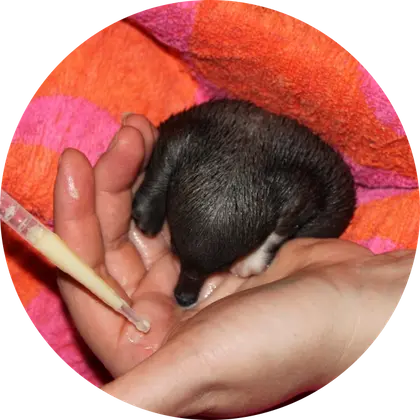
The baby echidna (puggle) hatches from the egg by using an egg tooth to crack the shell and pulls its way along the mother’s hair to the pouch area. During this period, it is believed that the female echidna starts to construct her nursery burrow, which normally consists of a metre-long tunnel with an enlarged area at the end where she will deposit her baby once it starts to grow spines.
The female echidna does not possess nipples or teats to feed her young. Instead, she has milk patches in her pouch area, where fine pores secrete the milk onto specialised hair follicles. The puggle suckles the milk at a rapid rate, whilst encouraging milk letdown through ‘nuzzling’ at the pouch area.
Once the puggle starts to grow spines (around 50 days of age), the mother will leave the baby in the burrow whilst she forages for several days at a time. She will return to the burrow every 4 to 6 days to feed the baby.
When the baby is around 200 days old, the mother will return to the burrow, dig the young out of the nesting area, and then emerge from the burrow with the young echidna. She will then leave the burrow entrance open. It has previously been believed that the mother will have no further contact with her young from that point, however wild echidnas have been observed to have a young one foraging with them. When an echidna is brought into care during the breeding season, it is imperative to remember that if it is a female she may have a young either in her pouch or in a burrow. Therefore, it is essential that she be returned to her place of rescue as quickly as possible and not relocated. It is very important to note the exact rescue location so she can be returned.
Echidnas are very spiky and handling them can be tricky. They are also extremely strong, can climb well and are great escape artists! It is important they are always placed into an appropriate container such as a tall plastic container (e.g. a 75 litre plastic rubber bin is ideal) with a secure lid with holes drilled in the lid for ventilation. A bath towel should be placed on the bottom of the bin and then a second towel placed over the echidna.
Echidnas do not tolerate high temperatures and excessive heat can lead to death. Never provide a heat source (such as hot water bottle) to an echidna. In hot weather, the bin should be kept in an air-conditioned room or car, so it does not overheat. Alternatively, one of the towels could be dampened slightly with cool water to keep the temperature below 25°C.
Echidnas will often avoid capture by digging themselves into the soil or other tight spots. It is very difficult to remove them without digging them out physically. NEVER use a shovel to dig an echidna out – only ever use your hands to prevent accidental injury to the animal. To remove the echidna, place a hand just behind the forelimbs on the underbelly. Echidnas can also be picked up when rolled into a ball with thick leather gloves to protect your hands.
For those that are not experienced with handling echidnas, the use of a pair good quality leather gloves are strongly recommended. Alternatively, use a thick towel (folded over) and wrap this around the echidna to pick it up.
If the echidna is injured and you are not able to capture the echidna quickly, please call your local wildlife rescue group. Even an injured echidna could dig faster than we can which often leads to them digging into inaccessible spots. They can be tricky animals to rescue so please call for help so an experienced echidna rescuer can attend.
Please note that unlike the platypus, the echidna does not have a venomous spur.
There are varied reasons why echidnas need our help, many of which are directly as a result of human impacts. We have listed below some of the common reasons why they need to be rescued and have provided some tips as to how YOU can help your local echidnas.
Echidna in the yard
Echidnas are very quiet animals (they do not vocalise at all) and move around mostly at night. They are very common in all areas of Australia including suburban areas and they are frequently found in people’s backyards looking for ants, termites and grubs. Most of the time, we don’t even know they are there until a family dog raises the alarm.
If you find an echidna foraging or moving through your yard, we encourage you to observe it from a distance and leave it to find its own way out. Generally, if it was able to get into your yard, it will be able to find its way out again. Echidnas are very secretive animals so they will not move on until they feel it is safe to do so. If they sense any disturbance (such as people or animals moving or talking nearby), they will remain stationary, attempt to dig and will not move on.
It is vital that echidnas are NOT moved more than 200 metres from their rescue location. Remember that they have very strong home ranges and if a female, they may have a baby in a burrow nearby. Moving the echidna away from the area will disorientate the mother and she won’t be able to find her baby to feed it.
Encounter with a dog
If you have a pet dog, please keep your dog contained inside until the echidna moves on safely. As echidnas can hide so easily, err on the side of caution for a few days and monitor your dog closely while it’s outside for any signs that it may have located it still in the yard.
When found, dogs will often bark, nip at, or attempt to dig at an echidna. If there is any chance at all that your dog may have nipped or scratched/dug at the echidna, please contact your local wildlife rescue group so a trained volunteer can rescue the echidna and have it vet checked.
Echidnas are difficult to assess in the wild because of their thick covering of quills and injuries from an encounter with a dog, are often difficult to identify. Injuries from a dog encounter can lead to infection and even death if not treated. Once checked by a wildlife vet, the wildlife rescuer will release it into nearby bushland.
If your dog has inadvertently come into contact with an echidna:
Motor vehicle accidents
Any echidna that has been hit by a vehicle, or suspected of having been, must come into care for a full veterinary assessment. The echidna’s thick spiny covering can obscure many injuries, and this, coupled with their inability to vocalise, means that very often the seriousness of their injuries is overlooked.
The most common injury found in vehicle strike echidnas is a fractured beak which is not easily identifiable without an x-ray. Even if the echidna moves off the road and appears to be moving okay, it could still have life-threatening injuries. When fractured, the echidna’s beak swells quickly and impacts on their ability to breathe. If left untreated, the swelling can close off their airway and they can suffocate. If the receptors in their beak are damaged they will have difficulty finding food which could lead to starvation and death.
If you find an echidna that has been hit by a car:
In Queensland, echidnas are classified as a ‘specialised species’. You must hold a special Rehabilitation Permit issued by the Department of Environment Tourism Science and Innovation (DETSI) or an accredited wildlife care group to care for echidnas.
Caring for injured and orphaned echidnas requires specialised skills and is generally undertaken by wildlife rehabilitators that have several years’ experience with caring for other species of wildlife.
If you are interested in learning how to rescue and care for echidnas, enrol to complete an echidna workshop through Wildcare.